


 Centauri Carbon 2 Combo
 Centauri Carbon
 OrangeStorm Giga
 Neptune 4 Max
 Neptune 4 Plus
 Neptune 4 Pro
 Neptune 4
 Mars 5 Ultra
 Mars 5
 Mars 4 Ultra
 Mars 4
 Saturn 4 Ultra 16K
 Saturn 4 Ultra
 Saturn 4
 Saturn 3 Ultra
 Jupiter 2
 Jupiter SE
 Mercury Plus V3.0
 Mercury XS Bundle
 Mercury X Bundle
 Mercury Plus V2.0
 Phecda Laser Engraver & Cutter
 Mini 250 g Filament Bundle
 PLA Filament 1.75mm Grey 10KG
 PLA Filament 1.75mm Black 10KG
 PLA Filament 1.75mm 4 Colors 10KG
 PLA Plus Filament 1.75mm Black 10KG
 PLA PLus Filament 1.75mm 4 Colors 10KG
 PLA Glow
 PETG Translucent
 PLA Wood
 PLA Marble
 PLA Metallic
 PLA Sparkle
 PLA
PLA PLA Basic
 PLA Plus
 Rapid PLA Plus
 PLA Pro
 PLA Filament 1.75mm Colored 2KG
 3 kg Filament Spool
 Rapid PLA Plus 5 kg Spool
 PLA Matte
 PLA Silk
 PLA Galaxy
 PLA-CF
 Rapid PETG
 PETG Pro
 PETG-CF
 PETG-GF
 TPU 95A
 PC
PC Rapid TPU 95A
 ASA
ASA ABS
ABS PAHT-CF
 Filament Vacuum Storage Bags Kit (20 Pcs)
 3D Paint Kit
 PEI Liquid Glue Pack (2 Pcs)
 Standard Resin V2.0 Grey 10KG
 ABS-like Resin V2.0 Grey 10KG
 Water-washable Resin Grey 10KG
 ABS-Like Ultra Resin
 Tough Resin
 ABS-Like Resin V3.0 Pro
 8K ABS-Like Resin V3.0
 Water-Washable ABS-Like Resin
 ABS-Like Resin V3.0+
 8K Standard Resin
 Rapid Standard Resin
 Standard Resin
 Standard Resin V2.0
 8K Water-Washable Resin
 Water-Washable Resin
 Water-Washable Resin V2.0
 ABS-Like Resin
 ABS-Like Resin V2.0
 ABS-Like Resin V3.0
 Plant-Based Resin
 Standard Plant-Based Resin
 Photopolymer Resin Detergent 5KG
 CANVAS for Centauri Carbon
 Marsmate Air Purifier
 Mini Air Purifier (2 Pcs)
 USB Air Purifier (2 Pcs)
 Activated Carbon Filter for Marsmate
 Mini Heater
 3D Stainless Steel Funnel
 Silicone Mat 2 Pcs
 For Centauri Carbon
 For Neptune 4 Series
 For Neptune 3 Series
 For Mars Series
 For Saturn Series
 For Jupiter Series
 LCD Screen
 Build Plate
 ACF/FEP/PFA
 Resin Tank
 Washing Bucket for Mercury Plus V3.0
 Washing Bucket for Mercury X/XS Bundle
 Washing Bucket for Mercury Plus V2.0
 Window Mirror for Phecda (6 Pcs)
 Enclosure for Phecda
 Risers for Phecda (8 Pcs)
 Rotary Attachment for Phecda
 Air Assist for Phecda
 Honeycomb Panel for Phecda
 Composite Filter for Phecda (5 Pcs)
 Laser Module for Phecda 20W





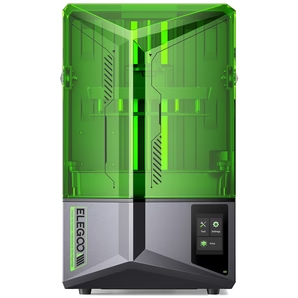


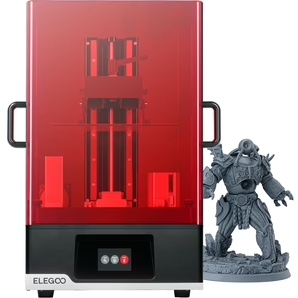















In the rapidly advancing field of biomedical research, rapid prototyping and accessible fabrication methods are essential to accelerating discovery and innovation. As part of their recent efforts, Juncker Lab, known for its work in microfluidics, biosensors, and bioanalytical technologies, continues its mission to advance biomedical research through innovative engineering approaches. This year, Juncker Lab took a bold step forward by integrating ELEGOO 3D printers, including the Saturn 3 Ultra, Mars 4, and Mars 4 Ultra, into their hands-on microfluidic fabrication workshops. This integration provided participants with a unique opportunity to explore cutting-edge microfabrication technologies in a practical, interactive setting.
Session 2: Capillary-Driven ELISA Assays on Printed Microfluidic Chips
In the second session, the focus shifted to functional biomedical applications. Participants fabricated capillary-driven microfluidic chips and conducted ELISA assays directly on their 3D-printed platforms. This hands-on experience highlighted how rapidly prototyped microfluidic systems can be used for real-world point-of-care diagnostic assays, showcasing their potential in clinical diagnostics.
Participants printing ELISA-on-a-chip devices during on-site training and demonstration.
Session 3: From Design to Functional Prototypes
The final session combined computer-aided design (CAD) tutorials with live 3D printing demonstrations. Participants were divided into six teams and challenged to design hydrogel-integrated multi-organ-on-a-chip (OoC) systems for drug screening. Under Junker Lab team supervision, each team successfully printed their prototypes using ELEGOO 3D printers. The exercise gave participants a full workflow experience, from digital modeling to fully functional microfluidic prototypes.
Participants printing hydrogel-integrated multi-organ-on-a-chip devices during the design challenge.
How ELEGOO Printers Supported Microfluidic Innovation
Before using ELEGOO machines, the team relied heavily on silicon wafers for cleanroom-based fabrication or DLP 3D printers for high-resolution printing of microfluidic components. A member of the Junker Lab team shared: “Compared to the tools we used previously, the ELEGOO LCD printers offer several significant advantages. LCD printers are now outperforming DLP 3D printers in both number of pixels and affordability, allowing for higher-resolution prints at a lower cost.”
Another team member noted that: "In practical terms, the larger build plate on the ELEGOO printer enables us to fabricate many microfluidic chips simultaneously, which greatly improves throughput. Tasks that previously required multiple printing cycles or cleanroom processes can now be completed in a single day, without compromising resolution or quality. This dramatically reduces both time and operational costs, making rapid prototyping and hands-on training much more efficient."
By the end of the project, participants had successfully completed a series of fully functional 3D-printed microfluidic devices, which were used in ELISA assays and microvalve fabrication. They also delivered prototype designs of hydrogel-integrated multi-organ-on-a-chip systems, which were printed and presented during the workshop's final demonstrations.
Reliable Tools that Enabled Seamless Prototyping
Reflecting on the workshop experience, the team described the ELEGOO printer as “a game-changer for our lab.” Its high resolution, ease of use, and generous build volume allowed them to quickly prototype functional microfluidic devices and molds, cutting down both time and cost compared to traditional methods. The reliable performance of the Saturn 3 Ultra, Mars 4 and Mars 4 Ultra supported each stage of the project, from mold creation to final device printing, contributing significantly to both the efficiency of the prototyping process and the success of the hands-on training sessions.
Photos of ELEGOO Saturn 3 Ultra and Mars 4 Pro being used by the team
Looking Ahead: A Broader Vision for 3D Printed Microfluidics
Building on the success of this year's workshop, Juncker Lab plans to continue incorporating ELEGOO 3D printers into future training and research initiatives. The team aims to host the workshops annually, providing more students and researchers with the opportunity to gain hands-on experience in 3D printing and microfluidic fabrication.
The lab is also exploring new frontiers by integrating 3D printed microfluidics with biosensors, hydrogels, and organ-on-a-chip platforms, advancing biomedical research and diagnostic technologies.


